Haiyan/Yolanda 001: When Cyclones Roar

They say that the floodwater came pungent and thick, the kind you could sink into and never rise from.

It’s been eleven days since super typhoon Haiyan, locally known as Yolanda, hit land in the Philippines. The news says it was the second deadliest typhoon to ever hit the country. A woman I met this week told me that her relatives described the sound of the storm like heavy weaponry being fired without stopping.

On that night, I was enjoying a quiet evening at home on the couch, while outside the wind blew with incredible strength. It rattled the open screen windows in our living room. I did nothing more than marvel at the force of the wind, close the windows and say a breath of prayer for those braving the storm in harsher conditions. I yet had no idea of the heartache this one storm would cause. In my mind, it was just another typhoon,  one of the very many we experience each year.

Super typhoon” was the term people were throwing around. In the days immediately before and after the storm, I stayed away from reading the news, insisting not to worry. Perhaps it was an exaggeration by the media, especially from nations unfamiliar with our local typhoons and cyclones. But really it was denial.
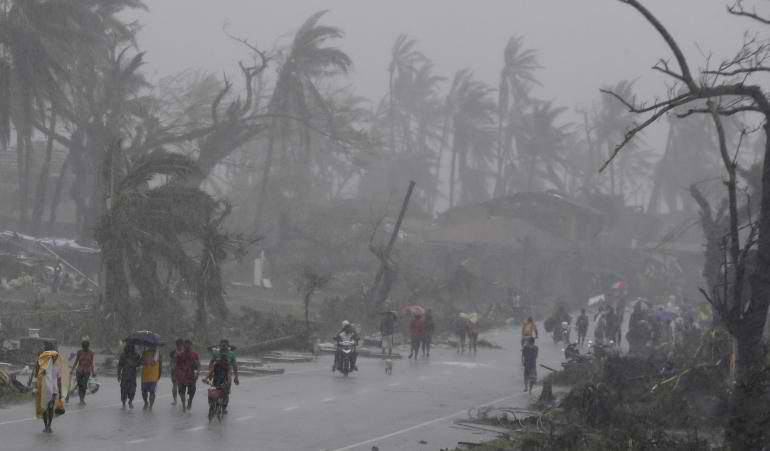
"Survivors walk on a road amidst heavy downpour after Typhoon Haiyan battered Tacloban city in central Philippines. One of the most powerful storms ever recorded has killed at least 10,000 people in the central Philippines province of Leyte, with coastal towns and the regional capital devastated by huge waves. Typhoon Haiyan destroyed about 70 to 80 percent of the area in its path as it tore through the province, according to local authorities." Reuters
“Survivors walk on a road amidst heavy downpour after Typhoon Haiyan battered Tacloban city in central Philippines. One of the most powerful storms ever recorded has killed at least 10,000 people in the central Philippines province of Leyte, with coastal towns and the regional capital devastated by huge waves. Typhoon Haiyan destroyed about 70 to 80 percent of the area in its path as it tore through the province, according to local authorities.” Reuters. From the International Business Times

People began to talk about the damage. Slowly the news from far-off Leyte and Samar trickled in. Calamity was more than confirmed. The world began to talk about it. And I continued to stay away from the news. Hearing about it was enough. Perhaps it was survivor guilt, or the mere physical distance from harm, or the crippling feeling like I couldn’t really help from where I was.

By this time, I was flooded with messages from friends around the world, asking me if my family and I were affected by the storm. As it is when you are far away, many friends seem to have imagined the worst. Friend’s messages were full of incredible concern because to them, I could have easily been on any one of those islands that were struck with the hardest blows. I live far north of those islands, but those unfamiliar with Philippine geography wouldn’t know that. Messages kept coming in. Some of them thickened with worry. Many of them from friends I hadn’t spoken to in a long time. And more and more, these messages connected dots that drew lines closer and closer to me. Though I had felt so physically and emotionally distant from the tragedy in the Visayan islands, the storm was finally coming to me.
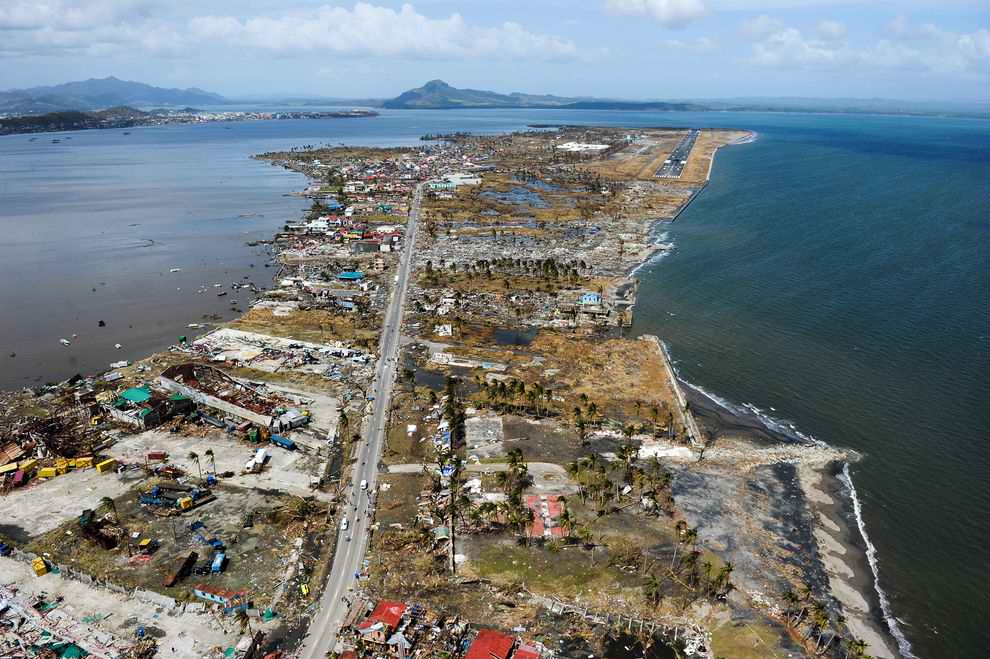
An aerial shot from a Philippine Air Force helicopter shows the devastation of the first landfall by Typhoon Haiyan in Guiuan, Eastern Samar province, central Philippines. From National Geographic. PHOTOGRAPH BY BULLIT MARQUEZ, AP
An aerial shot from a Philippine Air Force helicopter shows the devastation of the first landfall by Typhoon Haiyan in Guiuan, Eastern Samar province, central Philippines. From National Geographic.
PHOTOGRAPH BY BULLIT MARQUEZ, AP

I haven’t even had a chance to respond to all the messages, but made sure to post a general message on my Facebook timeline, to ease any unnecessary concern for my safety.  Much like the overflow of well wishes and concern in my direction despite my distance from tragedy, the Philippines is experiencing an outpouring of generosity from resources at home and abroad. The response to the immediate need has been incredible. In Manila, it seems we have all been mobilized- working on packing relief goods, raising funds or even driving survivors from one drop off point to their families in the city. A look through this collection of photos on the international response to the typhoon warms your heart. Sure, as with all disasters, there has been much talk about the pitfalls in the relief efforts, but to me that is negative energy we can do without. (I found this article quite appropriate.) There is still so much good being poured into the channels that need it. Let us continue to pour in.

We sang this song in worship, Still, at church on Sunday. And the words just cut my heart. When the oceans rise and thunders roar / I will soar with You above the storm/ Father you are King over the flood / I will be still, know You are God. I sang. I closed my eyes. And there I was, standing in the expanse of flattened wreckage of the damaged cities, now all but rubble. As far as I could see was gray sky and brown ruin, not another person in sight. Tears ran down my face, and I finally mourned with the millions that survive the disaster. 

When the storm of this news has lost its power completely, and the world has moved on to respond to other tragedies, I will not move. I will not let this rest. When international concern has blown away, I will find myself standing in the rubble, praying over the land, and playing with the children who have survived.

They say that the floodwater came pungent and thick, the kind you could sink into and never rise from. But life will be restored. And life will grow. 

Buhay Makulay 002: Treasure Simplicity

Some things in life can be simple.

There is so much on my mind these days. Things to accomplish, ideas to share, blessings to be thankful for. How often I have sat in front of this tab on my browser, “Add New Post,” eager to write a new blog entry. Yet each time I am tangled between so many different threads of life and thought, that my mind is left speechless. Numb, even.

I type a line or a phrase. Pause. Then highlight and delete it. Before I can complete a thought, I am taken away by a work meeting, an errand to run, a class to teach, or just boring old exhaustion. Hours, days, weeks later; I have a few empty drafts and nothing new. So here come my few centavos worth of thoughts, hoping to break this cycle of silence. And like most of my writing, it is less for the sake of being heard by others, and more to able to hear myself.

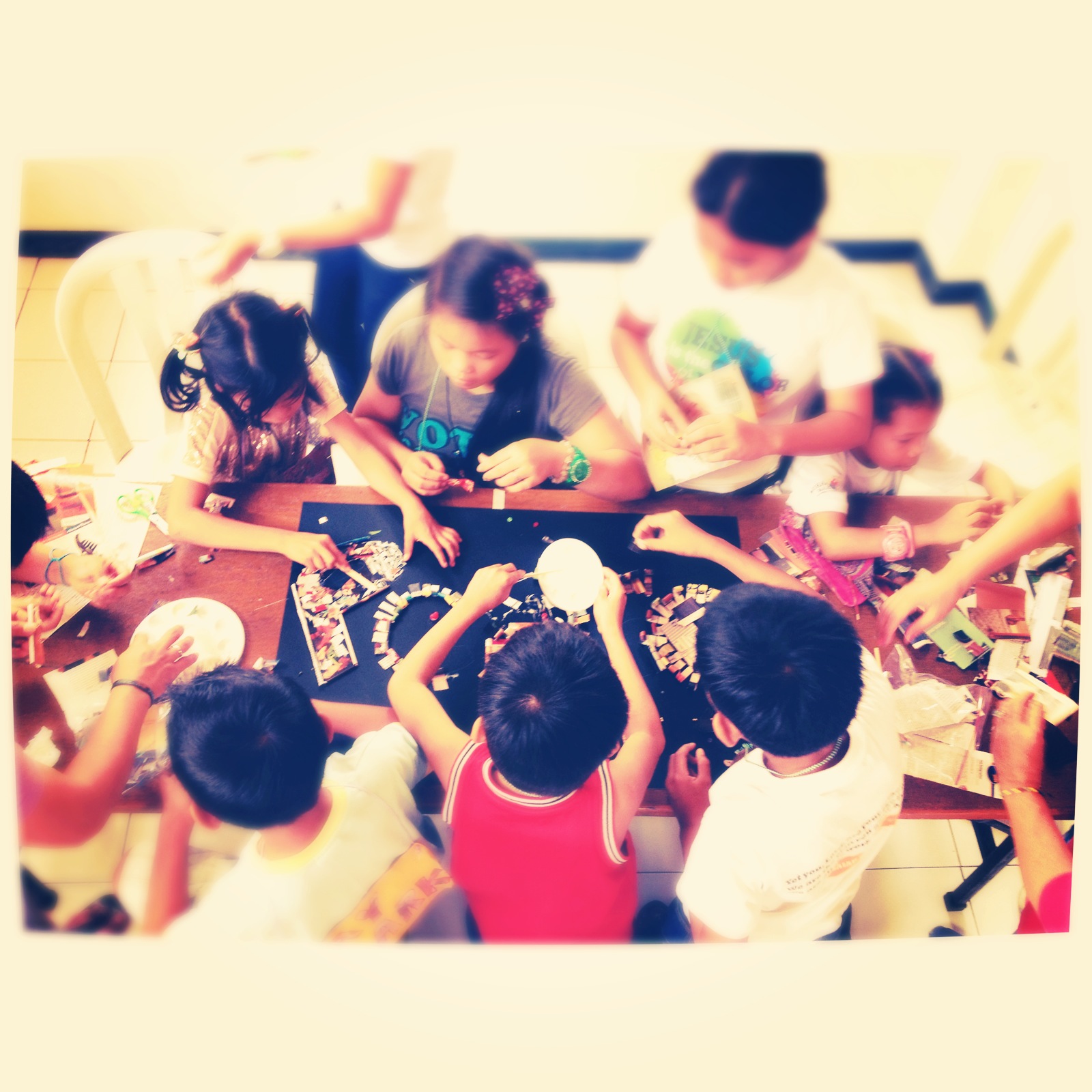
Yesterday, was the seventh workshop day of Buhay Makulay’s Likha Workshop series (7/10). To close off our volunteer’s debrief after lunch, I asked my team to go around the circle and share how the children pointed them to God that morning. One sentence.

likha

After they had all shared such beautiful and sweet spoonfuls of joy and learning, I was left with a reminder for my own heart that I in turn shared with them: Some things in life can just be simple.

There are things in life that will choose to be complicated. They will complicate themselves on their own without your help or desire. They will even refuse to be anything except complicated. A problem at work. A quarrel with your best friend. What to order at your favorite restaurant.

But, there are things in life that don’t have to be complicated at all, even if our human minds perceive them so. Like the truth that God is good. The human longing to belong. The desire to achieve a lifelong dream. The love of a father for a child. How to get to your afternoon meeting. Who to invite to your birthday celebration. Or what to cook for breakfast.

I have been very very very busy for the past few months. Probably the busiest I have been in the past year. In the midst of the craziness, I am finding clarity. In the overabundance of life happenings, I am almost forced to sift through all of it, looking carefully for the things that actually carry weight, to keep me grounded. The things that are worth holding on to, worth setting my eyes on.

I’d like to think I am continuously in the process of simplifying my life. This is not only the process of removing objects from my possession. Neither is it a mere reduction of activities, commitments or hobbies. It goes deeper into the surface than that: It is a paring down of the things that I regard with value. These, we can choose. When those things are clear and simple in your heart, no earthly complication can corrode it. Through the complexity, the truth will speak simply.

buhay makulay likha

How did I come to reflect about simplicity with my Buhay Makulay kids? I don’t know exactly. But in their company, the world somehow simplifies itself. Perhaps it is because we are taken away from our usual hectic daily-grind environments, where we are eaten up by worries both big and small. For the children, these worries on any given day could include where their next meal will come from, how they cannot go to school because of a parent’s illness, or a recent death of a family member. Mine, though not as grave and often tied less to immediate need, tend to feel just as urgent.

Yet the joy on the children’s faces will seldom reveal the losses of which they suffer or the needs that cannot be fulfilled. They will leave their worries at the door and enjoy a moment with you. With the swing of their voices in my ear as they tell me about their artwork, I know we are friends. And this friendship is simple. This moment is simple and true.

Let the world be complicated; but draw near to the things that keep you simply and genuinely you, without muddling for achievement, recognition, prize or gain.


(P.S. Happy 25th post, Speak Soon! YAY!)

What I Learned About Process + Learning, from the Process of Creating Art

Yesterday I had nowhere to be.

I could barely wrap my head around this predicament. For the first time in a long time, I had the luxury of having a whole day to myself! When was the last day I had nothing scheduled? No children’s workshop to run, no fitness classes to teach, no work to supervise, no meeting to attend, no reports to write, no spreadsheets to look over. Not a single pressing deadline! The daily grind could wait until tomorrow. Or even the day after. I was beginning to fear I was forgetting something!

You should probably stay home and do nothing then,” my brother told me when I shared my bare-boned Saturday plans, “This is rare.” With two day jobs and a number of volunteer positions – a quiet, slow day is a treasure!

Despite the day off, I was determined to do a number of things; a number of restful, enjoyable, life-enriching things:

1. Wake up slowly, but not too late in the day.  
2. Not do anything work-related – not even problem solving in my head, checking emails or reading work-related articles.
3. Write, read, or draw.  
4. Not waste away the day scrolling down social media news feeds.
5. Watch a film.
6. Do some chores. 

I don’t think I did too bad. I woke up a little after nine in the morning – not too early nor too late, with many free hours ahead of me! I steered away from even thinking of work obligations, and except for checking my email twice (just to make sure I wasn’t missing anything urgent!) I didn’t even look at my favorite management or leadership blogs. I wrote, read and drew. I spent very little time on the typical social media sites, even less than I do on a regular day. I watched multiple films, not just one – great sappy background to my drawing session, pairing well with the heavy rain outside. I even got my laundry done! (I had to feel at least a little bit useful!)

IMG_5506
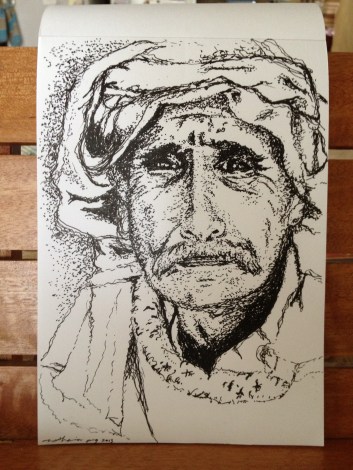
A drawing by yours truly.
Original photograph by Tim Barker, captioned, “At Petra in Jordan, a man wears the traditional costume of the Nabataean culture that established Petra as their capital around the 6th century BC.”

But really, I spent the entirety of my day drawing. (Read more about it here.) All the hours working in my sketchbook yesterday reminded me of the wealth of time I spent simply working on art in college. I had to, it was my major. And for every hour of class in college, you were expected to work a minimum of four more hours outside. More often than not, that wasn’t really enough time to get your work done. Making art is really much more time consuming than most people expect. You could be working on a square inch of space for days! A small piece of art is sometimes made up of thousands of tiny strokes, all patiently put together by hand.

studiowheat
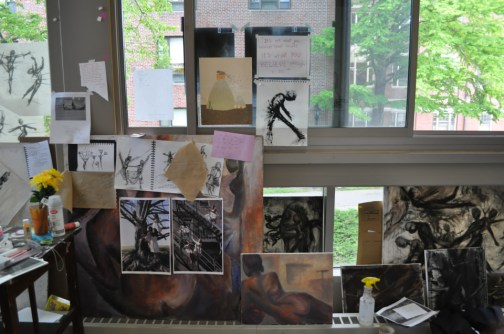
Slice of my senior year studio at college.

It was this process of creating art that really helped me understand more about the process of learning. Here are a few reflections:

1. Just put in the hours.
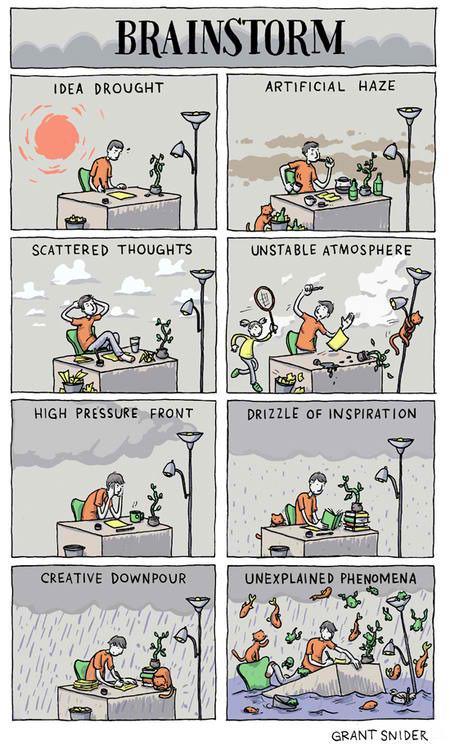
When you don’t, it shows. Sometimes the hours are spent staring into space or doodling aimlessly, your mind experiencing a drought of inspiration. Sometimes the hours are spent making “bad” work. Sometimes the hours are spent in tedium, drawing dot beside dot beside dot, or drawing and redrawing and redrawing the same darn green pepper. Put in the hours, even when you feel like there is no learning or no progress. It’s practice, it’s all an investment. Those hours clear the path for a mind-blowing moment later, that breakthrough you thought would never come.

creativeprocess2

2. Walk away from your work and come back. Then step back. Look at it from a different part of the room.
If you’ve ever stared at a single word long enough for it to become the most absurb collection of letters you have ever seen, then you know what a difference it makes to spend some time looking away. Stand too close to your work for too long, slaving over whether you have drawn that crease in the paper just right, and you may later discover that you obsessed over something of little importance to the sum of all parts. Stand too close to your work for far too long and it may appear absurd, flawed and out of proportion. Walk away for a minute and come back. Walk away for a day and come back. The space between you and your work will give you a fresh perspective, a point from which you can see how to move forward.

creativeprocess

3. Don’t be too precious about your work.
There was a time when I was given this advice often. I valued each simple sketch and drawing too much, instead of dismissing them to practice and process. If you’ve been able to draw it once, you can draw it again, my friend told me. I wasn’t accidentally making bad or good drawings. A single well-proportioned drawing wasn’t the last. They told me to trust in my skill and ability. I soon began to enjoy the impermanence of my sketches. I would draw a figure on the canvas with charcoal, then spray it with water, so that the charcoal dancer would dissolve and drip away. Then I would do it again. I would draw, then spray, And again. It was a healthy practice. When I began to let go of my work, it opened up my learning ability. Instead of hanging on to small victories, I was practicing towards creating work more profound than any of the quick sketches I had drawn and let drip away before it.

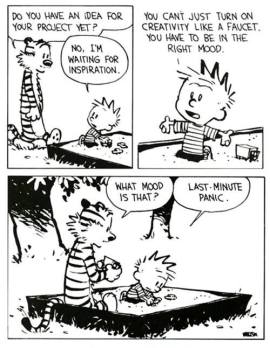
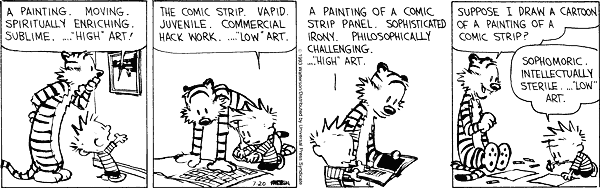
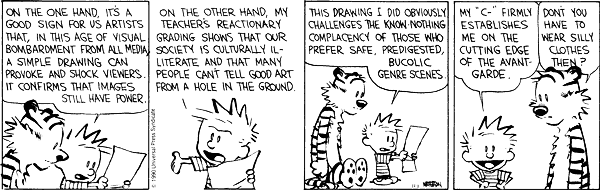
criticcalvin

4. Let someone have a look and give a word – even when it is still in progress.
We learned, worked and progressed in public space. We failed, fussed and made ugly mistakes in that public space too. This was an important difference between the studio art department and other academic departments. There was less private time for you to get an acceptable draft before eyes landed on the budding fruit of your labor. You can’t hide your embarrassing scribble of a portrait when your professor tells the class to take a walk around the room to see everyone’s progress (or your lack thereof!). You just have to surrender to the rawness.

Art students worked in the studios – day, night or both. Someone could be looking over your shoulder at any point from first pencil sketch to final painting, a witness to every awkward, misplaced, discolored mark in between. Of course this wasn’t always the case, but it encouraged humility. It was never just your best foot forward. Your dirty laundry was often in plain sight too. I ended up loving this process and even relying on it. I sought out the feedback from others to better understand and approach my work. You need people to respond to what you do, whether or not you’ll take their advice in the end. The friends I invited back to see my work or my studio, were those who took the time to form an opinion about my work and give a critique, no matter how brief or informal. Those that only had praises, they weren’t half as interesting or valuable to have around.

calvin artt

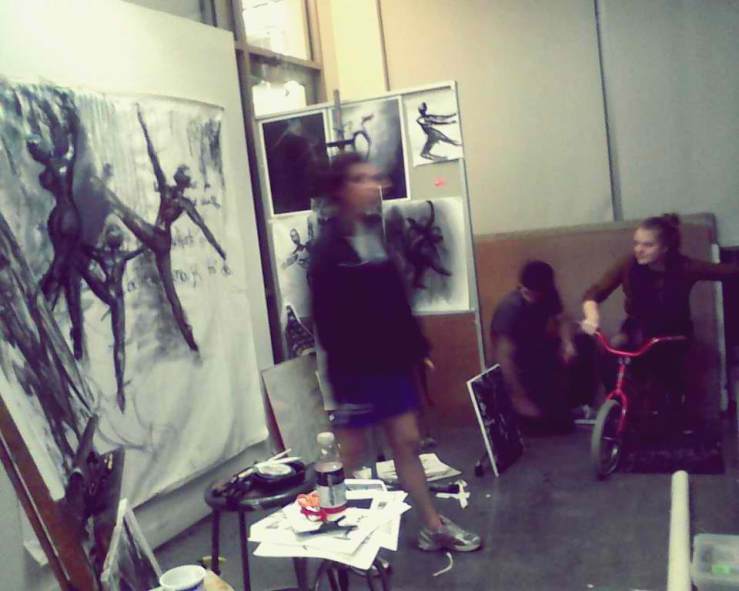
studiovis
Friends visiting my studio late one night. We all needed a break, a walk, maybe some extra hours of sleep.

I may spend less time on my art these days, but these lessons enrich my work. It’s no matter that I work in an environment so removed from the me that drew on a canvas with a stick of charcoal in one hand and a spray bottle in the other.

Thank you, Grant Snider and Bill Patterson for the comic strips in this post. 

Truth Thursdays: What’s in Your Hand?

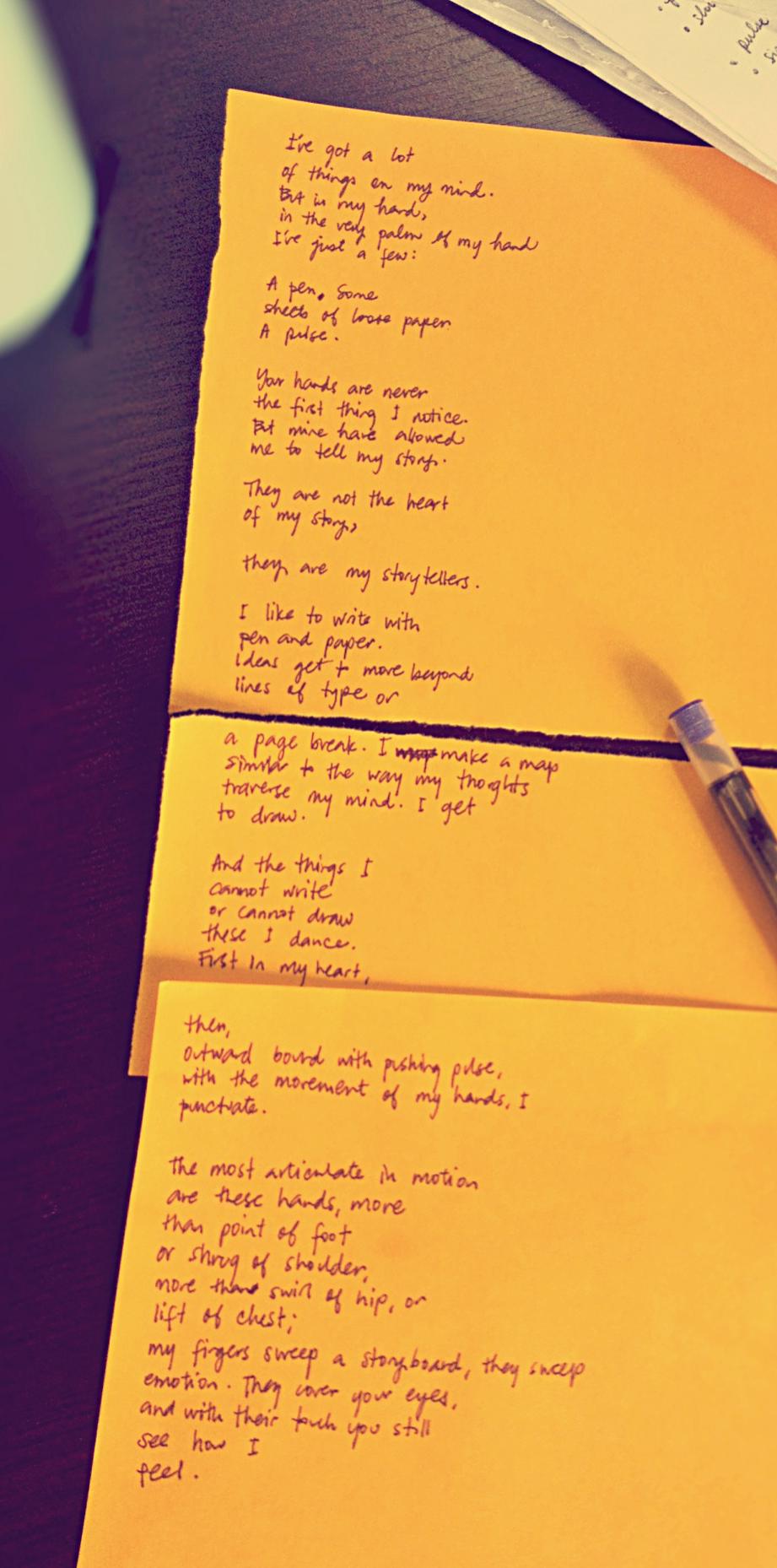
photo (6)_Fotor

And just in case you cannot read my handwriting:

What’s in Your Hand?

I’ve got a lot
of things on my mind.
But in my hand,
in the very palm of my hand,
I’ve just a few:

A pen. Some
sheets of loose paper.
A pulse.

Your hands are never
the first thing I notice.
But mine have allowed
me to tell my story.

They are not the heart
of my story,

they are my storytellers.

I like to write with
pen and paper.
Ideas get to move beyond
lines of type or
a page break. I make a map
similar to the way my thoughts
traverse my mind. I get
to draw.

And the things I
cannot write
or cannot draw,
these I dance.
First in my heart,

then,
outward bound with pushing pulse,
with the movement of my hands, I
punctuate.

The most articulate in motion,
are these hands, more
than point of foot
or shrug of shoulder.
more than swirl of hip,
or lift of chest;
my fingers sweep a storyboard, they sweep
emotion. They cover your eyes,
and with their touch you still
see how I
feel.

-Tanya Aritao

More about Truth Thursdays? Or more about this prompt.

Buhay Makulay: From Single Session to Season of Service

For the seventh year in a row, we celebrated our love for children with Buhay Makulay’s annual Children’s Fair. The  festivities were held two Saturdays back. This tradition began years ago, and ignited for me a deeper, lifelong commitment to community service in my home country. This coming Saturday, Buhay Makulay will be opening it’s first season of workshops ever, a dream I have held in my heart since the early days of Buhay Makulay.  This is the same dream that brought me back here to Manila. I am beyond excited!

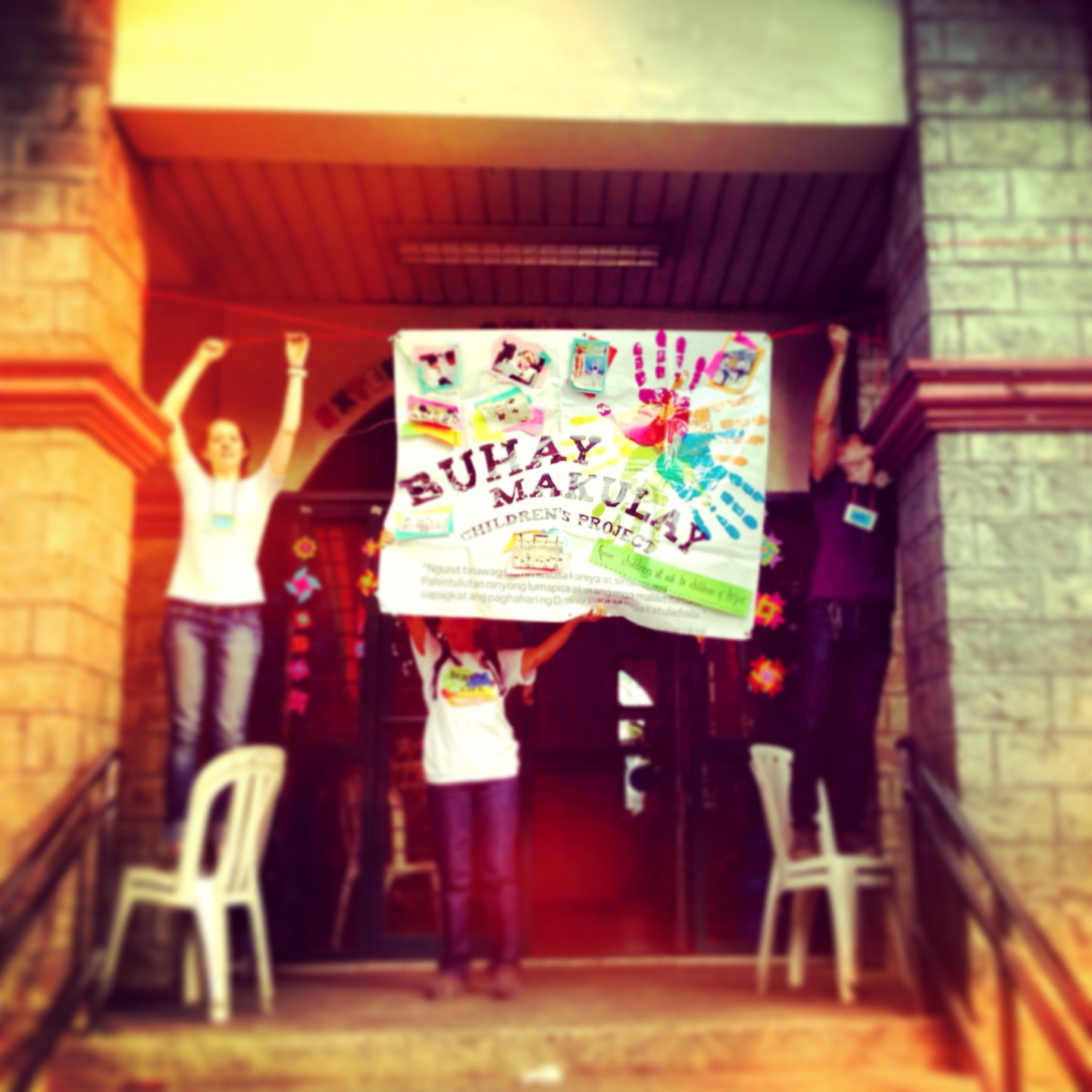
photo (6)
Getting ready to welcome the kids! June 22, 2013.

This present phase is very special for our organization. We are crossing over from single events to a more sustained presence in the life of the kids we reach out to. In the past, due to the restrictions of distance (I lived overseas!) or manpower, the work has been limited to stand-alone events – a morning fair, an afternoon workshop, or an evening performance concert (all valuable contributions to the existing work of our partner organizations, but never enough!). And although we have grown alongside some of our kids through the years, we still yearn for more. The time is ripe for bigger movement and deeper involvement. We want to form relationships, opening up real opportunities to mentor kids, and not just see them once a year. That’s where all of this was always headed!

DSC_0406_Fotor

So here comes our first season ever! It’s called Likha. In english that means “to create.”  Our inspiration is taken from Isaiah 64:8 “But now, O Lord, you are our Father; we are the clay, and you are our potter; we are all the work of your hand. “

Likha will give children the space to express themselves through visual and performance art. More than teaching about the arts, we will nurture a healthy community of children where each child feels loved and cared for. Our children represent the country’s poorest communities, families living with terminal illnesses like HIV/AIDS, or households torn down by abuse or abandonment.

We have been working on this for a long time and I cannot wait to see how the children respond to our pilot program. For the past few months, I have been meeting with my team of volunteers and our partners at the Precious Jewels Ministry. Slowly we’ve been pulling together ideas but more importantly, we’ve been knitting our hearts together as a team of volunteers, ready to serve and pour out love on these kids.

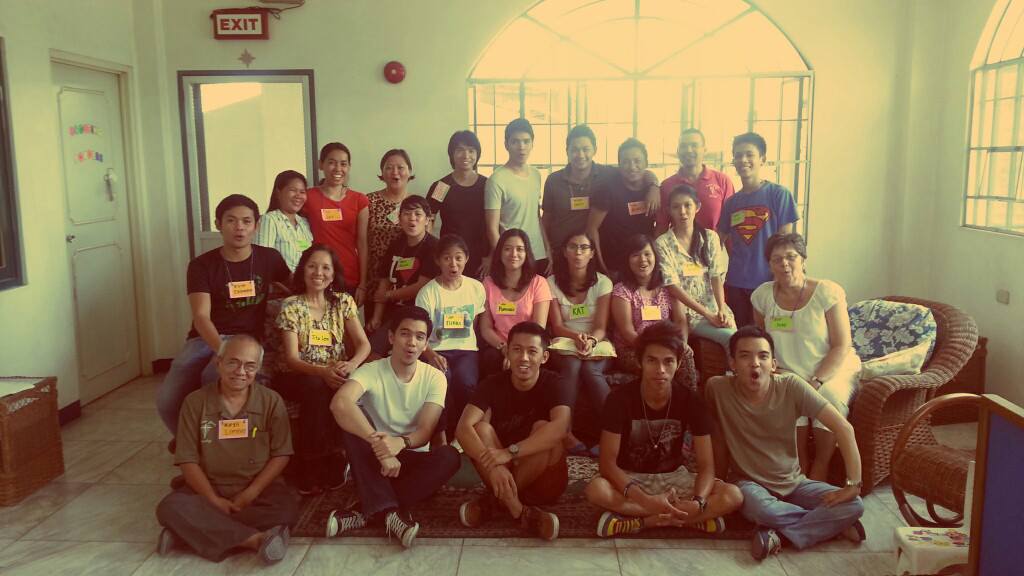
Some people behind Buhay Makulay and Precious Jewels Ministry. What a fun collaboration!

Looking forward to seeing the children this Saturday. We’ll be meeting twice a month all the way until December! We’re no strangers to the kids, but I am looking forward to being called their friend.

(On a fundraising note, we are still in need of sponsors for Likha. If you are interested to donate in cash or in kind, your gifts will go a long way. Please get in touch with me, or email buhaymakulaymanila@gmail.com for more info. To sponsor one child for the full program costs only P10,000 or $240. For a single session P1,000 or $24. )